
The era of traditional search is hitting a wall. AEO for B2B Saas is the new standard for being found in a world where AI does the heavy lifting. While organic traffic is getting squeezed by zero-click results, the SEO and AEO market is actually expanding. We saw a net increase of six major players this year alone. Winning in 2026 means moving past keyword stuffing. You need structured data, content built for LLMs, and a way to measure your “AI inclusion rate” instead of just counting clicks on a blue link.
By 2026, the top of the search funnel has been almost entirely reclaimed by AI assistants. The old “blue link” style of searching hasn’t vanished, but it has changed into something else entirely. Your prospects aren’t just typing keywords into a bar anymore. They’re asking their AI agents to find, vet, and recommend the best software for their specific needs. If your brand isn’t optimized for these answer engines, you’re invisible during the most critical part of the buyer’s journey.
Industry Context: The Great Shift
The market is showing us this change in real time. Even with the constant chatter about the death of SEO, the SEO and AEO subcategory grew by a net of six tools this year. While 38 legacy tools were retired, 44 new ones took their place. This 24 percent growth over the last year proves that making a brand findable and credible is getting more complex, not less. We’re moving into the era of Generative Engine Optimization (GEO), where being the “answer” is the only way to win.
1. Understand the Shift to Answer Engine Optimization
What we used to call SEO is now a much broader game. Answer Engine Optimization (AEO) is the art of influencing what an AI assistant says about your brand when a prospect asks a question. Marketers often feel like they’re flying blind because these AI journeys happen inside a “black box,” but you actually have a huge opportunity to shape the output. AEO for B2B Saas isn’t a side project anymore. It is the primary way to get in front of high-intent leads who are using LLMs to build their vendor shortlists.
2. Master Structured Data and Schema Markup
We’re still in the early days of figuring out how to talk to “Agents of Customers,” but one strategy is already a clear winner: publishing content that’s built for AI to read. Data shows that 63.1 percent of top marketers are now using heavy schema markup and structured FAQs. AI engines love this. It allows them to crawl your site and instantly understand your pricing, your core features, and your specific use cases. If the AI doesn’t have to guess, it’s much more likely to give a definitive answer that points back to you.
3. Leverage the New AEO Martech Stack
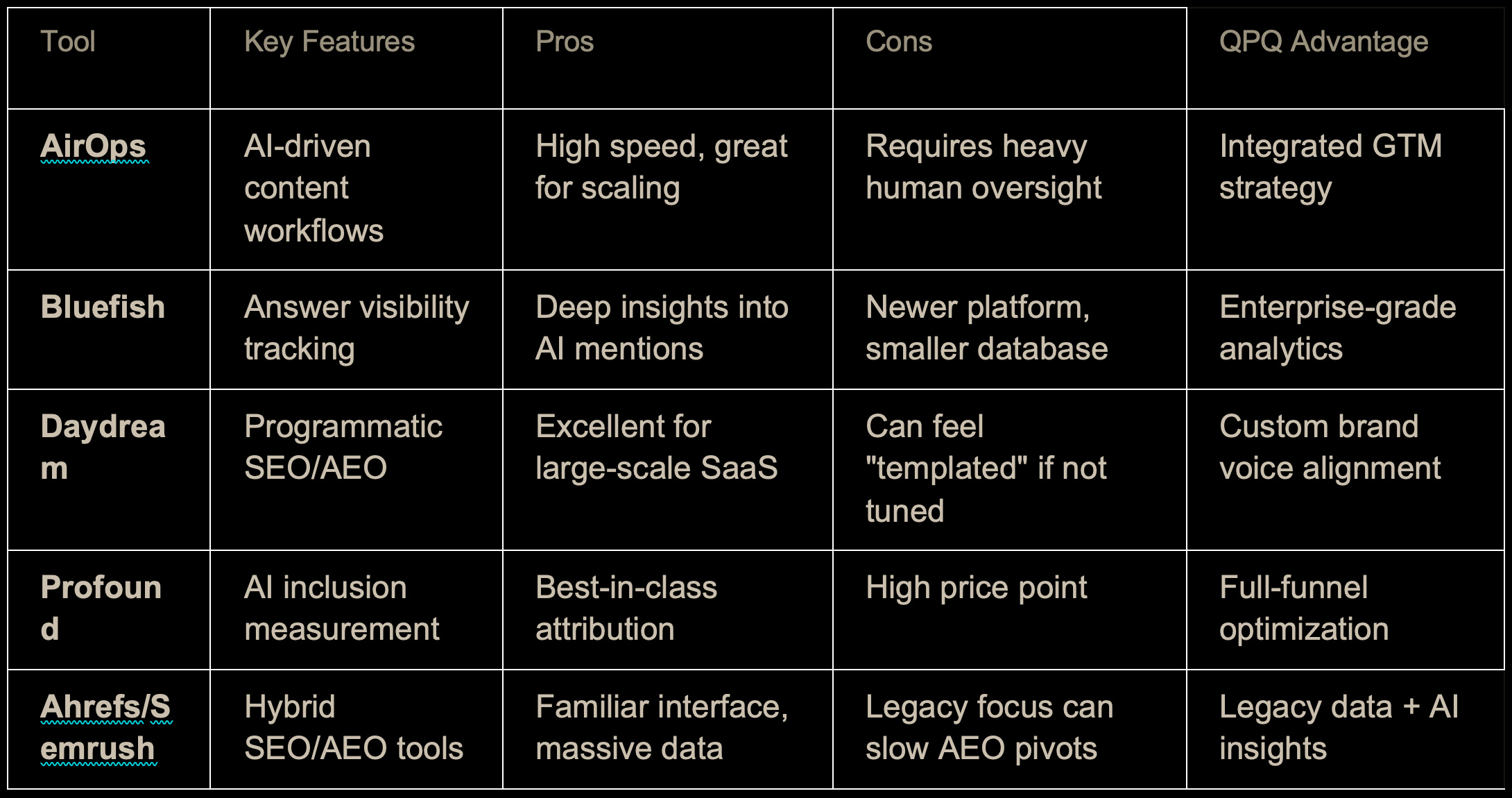
A new wave of tools has arrived to help you manage your AI visibility. These platforms focus on tracking your “AI inclusion rate” and making sure your content is ready for a generative response.
4. Focus on Credibility and Actionability
In the world of Generative Engine Optimization, just being found is only half the job. Your content has to be credible and it has to be actionable. AI engines are programmed to prioritize sources that show high authority and offer clear next steps. For a B2B SaaS company, this means your technical docs, your case studies, and your white papers have to be structured so an AI can cite them as evidence. If an AI can’t verify your claims, it won’t recommend you.
5. Measure AI Inclusion and Agent-Referred Conversion
It’s a bit strange that while 63.1 percent of marketers are making AI-friendly content, only 13.6 percent are actually measuring the results. This is the big measurement gap of 2026. To get AEO for B2B Saas right, you have to look past the old click-through rate. You need to track how often your brand appears in AI answers and how many of your conversions are actually being driven by AI agents acting on behalf of a human buyer.
Did You Know?
In 2026, zero-click searches are at an all-time high. Despite that, the SEO and AEO sector is one of the most positive parts of the martech world, growing at a steady 24 percent rate for three years straight.
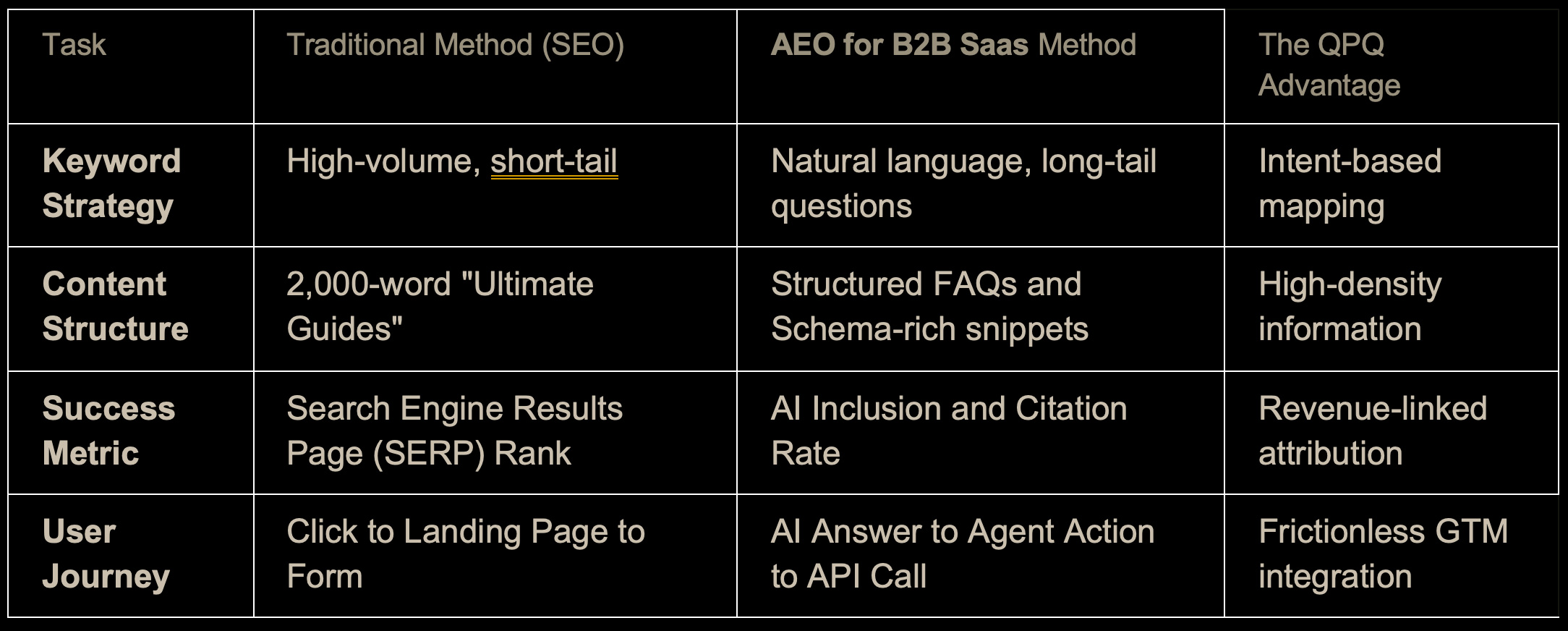
Quick Reference: Traditional SEO vs. AEO for B2B SaaS
What is the difference between SEO and AEO, and which one should businesses focus on in 2026?
The main difference is where the user ends up. SEO is about ranking in a list of links. AEO is about being the single, synthesized answer that the AI provides. In 2026, you really have to do both, but the momentum is moving toward AEO. More and more users are moving to AI-first interfaces like ChatGPT, Claude, and Perplexity for their initial research.
Should SaaS companies invest in GEO/AEO in 2026?
Yes. Investing in GEO is no longer a choice if you want to stay relevant. AI agents are now doing the heavy lifting when it comes to vetting vendors. If you don’t optimize for these engines, your product won’t even make it onto the shortlist that the human decision-maker eventually sees.
How to earn visibility in AI answers for B2B SaaS?
Visibility comes from a mix of technical precision and content authority. You need the right schema and fast load times, but you also need your brand mentioned on high-authority third-party sites. LLMs use these outside mentions as trust signals when they decide which software to recommend.
Firm-Specific Solution: The QPQ Advantage
At QPQ Marketing Agency, we’ve moved past just “doing SEO.” We build findability engines. We know that AEO for B2B Saas is an enterprise-level challenge. It requires a partner who understands how GTM strategies, AI behavior, and martech all fit together.
Whether you’re a startup looking to scale or a global company, QPQ has the technical skills to run advanced AI Engine Optimization strategies. We help you close the measurement gap by using custom analytics that track your AI inclusion rates and agent-driven conversions. We make sure your marketing budget is tied directly to your pipeline. Our approach combines the solid foundation of traditional SEO with the real-world requirements of the 2026 generative landscape.
Main Takeaways
- SEO is changing: It isn’t about blue links anymore. It’s about being visible across all AI-driven platforms.
- Structure is everything: The most successful marketers are using schema and structured FAQs to feed the LLMs exactly what they need.
- Track the right things: Don’t be one of the 86.4 percent of companies that aren’t tracking their AI inclusion rates.
- AEO is the result of quality: You can’t get good AEO results without a foundation of high-quality, authoritative content.
Pro Tips
- Check your AI Persona: Use tools like Profound or Bluefish to see how AI engines describe your product right now. If they’ve got it wrong, fix your structured data immediately.
- Lean into “Zero-Click”: Don’t fight the fact that people aren’t clicking through as much. Instead, give the AI the full answer in your schema so it cites you as the expert source.
- Make your site “Agent-Friendly”: In 2026, a lot of your “visitors” are actually AI agents. Make sure your site has a clear, machine-readable path so these agents can take actions like booking a demo.
Is traditional SEO dead?
No. It’s just evolving into AEO for B2B Saas. The core ideas of authority and relevance still matter, but the way people get their answers has shifted.
What is the most important metric for AEO?
The AI Inclusion Rate. This tells you how often your brand is being included in the answers generated by major LLMs.
How do I start with Generative Engine Optimization?
Start with an audit of your current content. See if it’s “AI-ready” by checking for structured FAQs and proper schema markup on all your product pages.
Can I use AI to write my AEO content?
You can, but be careful. Tools like AirOps are great for scaling, but you still need a human to ensure the content is actually credible. AI engines can tell the difference between fluff and authority.