

By 2026, the era of the massive “content factory” is over. High-volume, high-intent publishing no longer requires a dozen full-time staffers. By adopting an AI-first B2B SaaS content strategy, lean teams are reducing production time from weeks to hours while increasing output by 500 percent. This guide breaks down the exact blueprint for automating research, briefs, and creation to dominate both traditional search and the new world of Answer Engine Optimization (AEO).
The year 2026 has officially closed the book on the traditional content department. For the last decade, B2B leaders operated under a simple, expensive assumption: if you want more organic growth, you hire more people. You needed more writers to hit the word counts, more editors to fix the prose, and more SEO specialists to guess what the algorithms wanted.
That model is now a competitive liability. It is too slow, too expensive, and fundamentally mismatched with how buyers find information today. Recent market shifts show that over 68 percent of B2B leaders have moved away from human-only production. They are shifting toward AI-optimized workflows and structured data feeds that satisfy both human readers and the AI agents that now mediate the web.
If your internal pipeline still takes 14 days to push out a single white paper, you are effectively invisible. The modern B2B SaaS content strategy is no longer about managing people. It is about managing systems. We are witnessing a shift where “high-intent” content is defined by its ability to be machine-readable and agent-ready. This goes far beyond keyword density. It is about Model Context Protocol (MCP) servers, structured Q&A, and factual density.
The Thesis: Automation is the Only Path to Relevance
Any B2B SaaS company relying on a traditional, human-only content team will likely be priced out of the market by 2027. The math is brutal. The cost of manual production is too high and the velocity is too low to compete in a world where AI search engines like Perplexity, SearchGPT, and Claude prioritize “citations” and “structured facts” over generic long-form articles.
A winning strategy today requires a lean, AI-augmented approach. You have to treat your content as data, not just prose. This means moving from a “creative agency” mindset to a “data architecture” mindset.
Industry Context: The 2026 Landscape of AI-Driven GTM
The market has moved from “AI-assisted” (using a bot to write an outline) to “AI-native” (the entire workflow is built on a foundation of LLMs). In 2026, the barrier to entry for high-quality content has vanished. Anyone can generate a 2,000-word article. However, the barrier to visibility has skyrocketed.
Search engines have evolved into Answer Engines. Your B2B SaaS content strategy must account for how AI agents consume and summarize your site. Current industry consensus suggests that publishing two to three high-intent articles per week is the bare minimum for maintaining organic momentum.
Doing this manually costs an average of $15,000 to $25,000 per month in agency fees or internal salaries. By contrast, an automated workflow reduces this cost by 80 percent. More importantly, it often exceeds the quality of human-only briefs because AI can analyze thousands of data points and competitor pages in seconds.
The “Why”: Internal Data on the AI Transformation
Our research into the AI transformation of B2B Go-to-Market (GTM) strategies reveals a massive gap between traditional methods and AI-driven workflows. When we look at the most time-consuming tasks in a B2B SaaS content strategy, the numbers show a clear path to obsolescence for the old way of working.
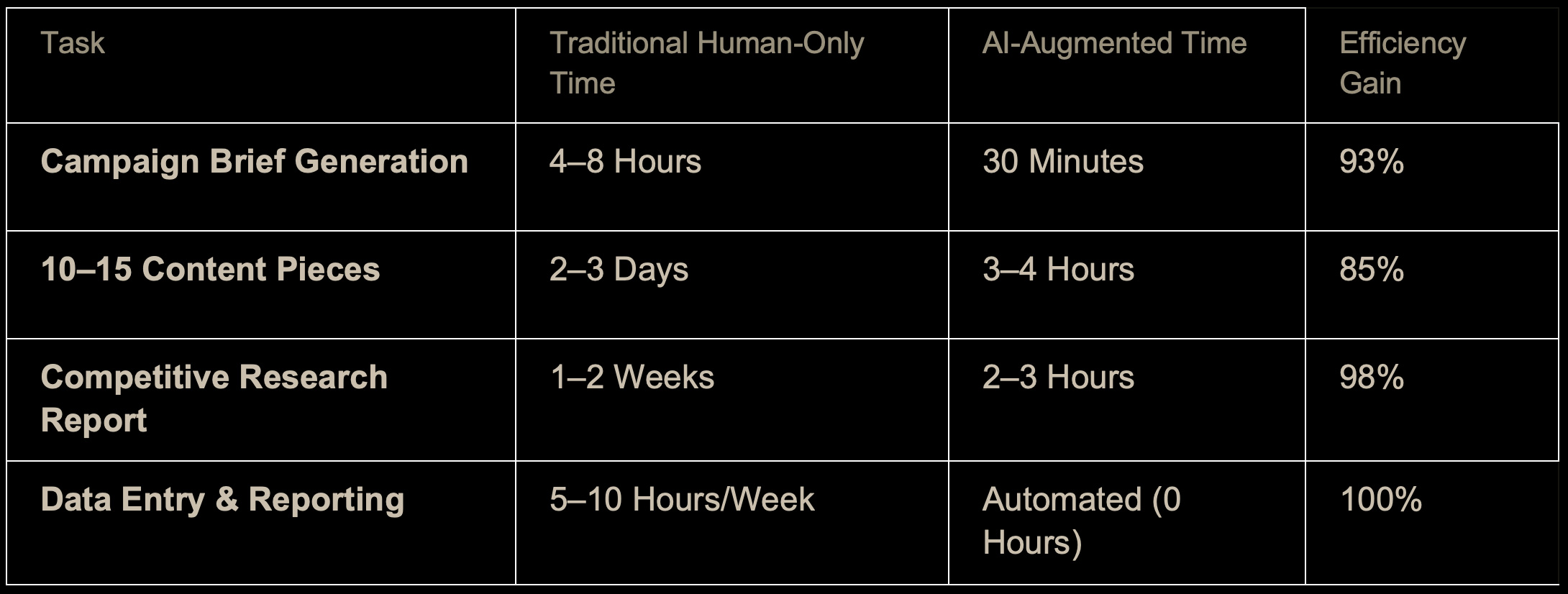
The reduction in resource drain is not just about saving money. It is about agility. If a competitor launches a new feature on Tuesday, an AI-augmented team can have a comprehensive comparison guide and three supporting use-case articles live by Wednesday morning. A traditional team is still scheduling the first brainstorming meeting at that point.
The Blueprint: How to Publish 2 High-Intent Articles a Week Without a Content Team
To execute this, you do not need a bigger team. You need a better stack. Here is the step-by-step framework for building an AI-first content engine that produces high-quality, high-intent assets.
Step 1: Build Your “Context Warehouse”
The biggest mistake companies make with AI is treating every prompt as a fresh start. This leads to generic, “hallucinated” content. To sound like a human expert, the AI needs your specific context.
Start by building a central repository of your brand’s “truth.” This should include:
- Your product documentation and API docs.
- Transcripts of successful sales calls (Gong or Chorus exports).
- Your “Point of View” (POV) on industry trends.
- Customer case studies and specific ROI metrics.
By feeding this into a Model Context Protocol (MCP) or a custom GPT knowledge base, you ensure the output is grounded in your actual business logic, not generic internet training data.
Step 2: Automate the “Briefing” Phase
The “brief” is where most content goes to die. In a traditional setup, a strategist spends hours researching keywords and competitor angles.
In an AI-first workflow, you use agents to:
- Scrape the top 10 search results for a target query.
- Extract the “information gap” (what are all these articles missing?).
- Cross-reference the query with your internal “Context Warehouse” to find a unique angle.
- Generate a structured brief that includes the target audience, the core problem, the solution, and the required data points.
This takes 30 minutes instead of a full workday.
Step 3: The “Human-in-the-Loop” Production
We are not advocates for “unfiltered” AI content. Pure AI output often lacks the nuance and “soul” required to convert a skeptical B2B buyer. The secret is the 80/20 rule: let the AI do the 80 percent of the heavy lifting (drafting, structuring, citing) and let a senior subject matter expert (SME) do the 20 percent (adding personal anecdotes, refining the “voice,” and verifying claims).
The workflow looks like this:
- AI generates the first draft based on the high-context brief.
- The Editor (you or a single hire) reviews the draft for “punchiness” and logical flow.
- The SME adds one or two “golden nuggets” (original insights that only a human with industry experience would know).
Step 4: Optimizing for Answer Engines (AEO)
In 2026, you aren’t just writing for Google. You are writing for the LLMs that power search. These models look for structured facts and clear citations.
To win here, your content must:
- Use Schema Markup extensively so AI agents can easily parse your data.
- Include “TL;DR” summaries at the top of every post.
- Use direct, declarative language. Instead of “Our solution might help you achieve better results,” use “Our platform reduces churn by 22 percent for enterprise SaaS teams.”
- Provide “Structured Q&A” sections that mirror the way users ask questions to AI bots.
Step 5: The Distribution Loop
Content that sits on a blog is a wasted asset. An AI-first strategy uses automation to turn one high-intent article into a distribution ecosystem.
- LinkedIn Snippets: Use a prompt to extract the three most controversial or insightful points from the article for social posts.
- Newsletter Summaries: Automatically generate a condensed version for your email list.
- Webinar Outlines: Turn the article’s structure into a slide deck or talking points for a video.
The Devil’s Advocate: Won’t This Hurt My Brand?
The most common pushback is that “AI content is low quality.” This is only true if you use AI as a replacement for thinking. If you use AI as a replacement for typing, the quality actually goes up.
By removing the “grunt work” of drafting and researching, your best people are free to spend their time on strategy and high-level creativity. You are moving from being a “writer” to being a “curator and architect.”
The risk is not in using AI. The risk is being the company that still pays $2,000 for a single article that takes three weeks to produce while your competitor is publishing high-quality, data-backed insights every 48 hours for a fraction of the cost.
Final Thoughts: Start Small, Scale Fast
You do not need to fire your marketing team tomorrow. Start by automating one specific part of the process: the research or the briefing. Once you see the efficiency gains, move to the drafting phase.
The goal for 2026 is simple: publish more, spend less, and ensure every word you put on the internet is designed to be found by both the humans who buy your software and the AI agents that guide their decisions. The “Content Factory” is dead. Long live the Content Engine.