

By 2026, the explosion of B2B SaaS tools has reached a breaking point. The average company now manages 17 distinct platforms, leading to a fragmented mess of data and missed opportunities. To survive, organizations are shifting from manual operations to GTM Systems powered by Pipeline engineering. This transition replaces fragile spreadsheets with programmable infrastructure, allowing teams to run 3.2x more experiments and reclaim thousands of manual labor hours.
GTM Systems and the Evolution of Pipeline engineering
The year 2026 marks a definitive shift in how revenue is generated. We have moved past the era of “growth at all costs” and entered the era of “growth through precision.” According to recent industry data, GTM engineer roles have grown by a staggering 205% year over year. Top tier talent in this space now commands salaries up to $241,000. This isn’t just a hiring trend. It is a fundamental restructuring of the revenue engine.
For years, companies relied on “duct tape” solutions like basic Zapier sequences and manual CSV uploads to keep their sales and marketing tools talking. But as the average B2B revenue stack expanded from 9 tools in 2021 to 17 in 2026, the duct tape snapped. Today, GTM Systems are no longer just about choosing the right CRM. They are about Pipeline engineering: the practice of designing, building, and optimizing the technical infrastructure that allows revenue teams to acquire and retain customers at a scale that was previously impossible.
The Catalyst: Why Manual Ops Died in 2026
The death of manual operations was triggered by three converging forces. First, the sheer volume of data providers (ranging from intent signals to verified contact info) became too complex for a human to manage. Second, the “signal to action” window shrunk. If a lead shows intent, they must be routed in seconds, not hours. Third, 75% of tech decision makers are now facing severe technical debt, forcing a move toward “programmable infrastructure.”
When we look at GTM Systems, we are looking at the machines that execute the strategy. If Revenue Operations (RevOps) is the architect drawing the blueprints, Pipeline engineering is the construction crew building the automated skyscraper.
The Technical Debt Trap
Most companies are currently suffocating under the weight of their own tools. Every time a new tool is added to the stack without a proper GTM System in place, the complexity grows exponentially. By 2026, this reached a tipping point where the cost of managing the tools exceeded the value they provided. This is why we see a shift toward modularity.
Modern Pipeline engineering treats the tech stack like a codebase. You don’t just “plug and play.” You build integrations that are resilient, documented, and scalable. This approach eliminates the “black box” problem where nobody knows why a lead wasn’t routed or where a specific data point originated.
Data Evidence: The Leverage of GTM Engineering
The impact of moving toward engineered GTM Systems is quantifiable. Internal benchmarks from Q1 2026 show that teams with dedicated Pipeline engineering resources ran 3.2x more outbound experiments per quarter than those relying on traditional RevOps.
This leverage comes from replacing manual SDR hours with “unattended pipelines.” A single well built playbook connecting data providers, webhooks, and CRM orchestration can replace 4 to 5 manual hours per week per SDR. For an enterprise team of 50, that is 250 hours of high value time reclaimed every single week.
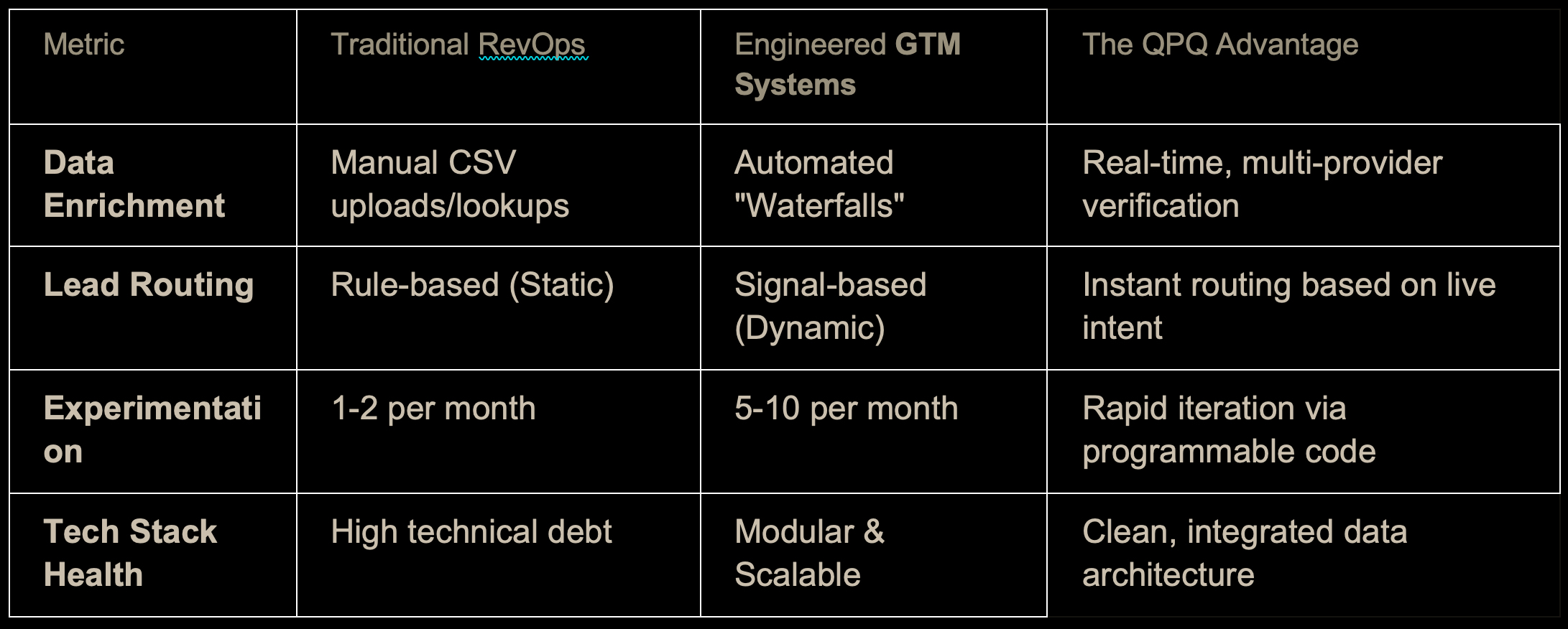
Did You Know?
In 2026, 75% of B2B companies report that “technical debt” in their CRM is the #1 barrier to hitting revenue targets. GTM engineering is now considered a “top 3” priority for CTOs, not just CMOs.
Is GTM Engineering just RevOps with a new name?
This is the most common question we hear, and the answer is a firm “No.” While RevOps focuses on the strategy and process maps, Pipeline engineering focuses on the code and infrastructure.
A RevOps manager thinks in terms of Salesforce reports and process flows. A GTM engineer thinks in terms of functions, webhooks, scheduled jobs, and API orchestration. RevOps defines the “what” and “why.” GTM Systems engineering builds the “how” that runs unattended.
Think of it this way: RevOps decides that every lead from a specific industry should get a personalized white paper. The GTM engineer writes the script that identifies the lead, scrapes their latest LinkedIn post for context, generates a custom intro using an API, and pushes the final document into the sales rep’s hands before the lead has even closed their browser tab.
Do GTM Engineers need to know how to code?
Yes. Unlike traditional marketing ops roles that might rely on “no-code” tools, modern Pipeline engineering requires a deep understanding of Python, SQL, and API structures. In 2026, the complexity of GTM Systems has surpassed what “drag and drop” builders can handle. To build a truly competitive advantage, you need the ability to write custom logic that connects disparate data sources into a unified revenue stream.
No-code tools are great for simple tasks, but they often lack the error handling and logging necessary for enterprise-grade operations. When a $500,000 deal is on the line, you don’t want to rely on a “Zap” that might fail because of a minor API change. You want a robust, engineered system.
How do you measure the ROI of GTM Systems?
The ROI of GTM Systems is measured through “Leverage” and “Velocity.”
- Leverage: How many manual hours were eliminated through automation? If your engineering team builds a system that replaces the manual data entry of 10 people, the ROI is immediate.
- Velocity: How much faster does a lead move from “Intent Signal” to “Booked Meeting”? In a world where the first responder wins the deal 50% of the time, speed is everything.
- Experimentation Rate: How many new market hypotheses were tested and validated this quarter? Pipeline engineering allows you to fail fast and scale what works without a massive manual lift.
See our related guide on GTM Systems and pipeline engineering for a deep dive into ROI modeling.
The Anatomy of a “GTM Waterfall”
One of the most powerful concepts in Pipeline engineering is the enrichment waterfall. In the past, companies would buy a license to one data provider and hope for the best. If that provider didn’t have a lead’s phone number, the SDR was out of luck.
A GTM System uses code to check Provider A. If the data is missing or unverified, it automatically queries Provider B, then Provider C. This happens in milliseconds. The result is a 99% hit rate on accurate contact data, ensuring your sales team never wastes time on “ghost” profiles or bounced emails.
Future Impact: The Next 12-24 Months
As we look toward 2027 and 2028, GTM Systems will become increasingly “AI-native.” We are moving away from static automation toward “agentic” pipelines. In this future, Pipeline engineering won’t just route a lead. It will deploy an AI agent to research the prospect, draft a personalized brief for the rep, and even suggest the optimal time to call based on historical data.
Companies that fail to invest in the technical side of their go-to-market strategy will find themselves out-competed by smaller, more agile teams that use GTM Systems to punch far above their weight class. The “moat” of the future isn’t just your product. It’s the efficiency of your revenue machine.
Preparation: Practical Steps for the Reader Now
If you are looking to modernize your GTM Systems, start with these three steps:
- Audit your “Duct Tape”: Identify every process that currently requires a manual CSV export or import. These are your first candidates for Pipeline engineering. If a human is moving data from one place to another, you have a system failure.
- Hire for Technical Depth: When looking for your next RevOps hire, prioritize candidates with SQL and Python experience. You need builders, not just administrators.
- Modularize your Stack: Stop looking for “all in one” tools that claim to do everything. They usually do nothing well. Instead, build a modular stack where every tool is connected via robust APIs and webhooks.
Firm-Specific Solution: The QPQ Advantage
At QPQ Marketing Agency, we don’t just give you a strategy. We build the machine. We are an enterprise-grade, industry-agnostic partner that specializes in the intersection of GTM Systems and Pipeline engineering. Whether you are a scaling startup or a global enterprise, we solve the “17 tool problem” by creating programmable infrastructure that replaces manual labor with high-velocity revenue engines.
Our approach to GTM Systems ensures that your data is verified, your signals are routed in real time, and your revenue team is focused on closing deals, not cleaning spreadsheets. We bridge the gap between software engineering and go-to-market strategy, providing the technical leverage you need to dominate your market in 2026 and beyond.
Main Takeaways
- GTM Systems have evolved from simple toolsets into complex, programmable infrastructure.
- Pipeline engineering is the key to scaling outbound experiments and reclaiming manual labor hours.
- The average B2B company now uses 17 tools, making manual integration impossible.
- GTM engineers are the new power players in the revenue org, combining code with strategy.
Pro Tips
- The “Waterfall” Hack: Don’t rely on one data provider. Use Pipeline engineering to build “enrichment waterfalls” that check Provider A, then B, then C to ensure 99% data accuracy.
- Signal-to-Rep Routing: Automate your intent signals so they hit a rep’s Slack or CRM within 60 seconds of the action. Speed is the ultimate conversion factor in 2026.
- Version Control Your Process: Treat your automated workflows like software. Document the logic, track changes, and have a rollback plan if an integration breaks.
What is the difference between a GTM Engineer and a Sales Ops Manager?
A Sales Ops manager focuses on the process and reporting within the CRM. A GTM engineer builds the technical pipelines (using code and APIs) that feed data into that CRM and automate the handoffs between different tools in the stack.
Why is Pipeline engineering becoming so popular now?
Because the complexity of the B2B tech stack has outpaced the ability of humans to manage it manually. With 17+ tools in the average stack, companies need engineers to ensure data integrity and process automation.
Can small companies benefit from GTM Systems?
Absolutely. In fact, small teams gain the most leverage from Pipeline engineering. It allows a small group of people to perform the output of a much larger organization by automating the repetitive “grunt work” of sales and marketing.
Final Verdict
The data is clear: the future of revenue is engineered. GTM Systems and Pipeline engineering are no longer optional “nice to haves” for tech-forward companies. They are the foundational requirements for any business that intends to scale in the modern era. By replacing manual processes with programmable infrastructure, you aren’t just saving time. You are building a competitive moat that is impossible to cross with manual effort alone.