
In a world where AI-generated content is the baseline, the B2B SaaS Video has evolved from a nice-to-have marketing asset into the primary engine of Pragmatic Product-Led Growth. To win in 2026, your launch video must bridge the gap between delightful end-user utility and C-Suite value realization. You have to move beyond flashy motion graphics to show, not just tell, the end-to-end user experience.
“So, I just saw another ‘revolutionary’ SaaS launch video,” my colleague Pete said. He was leaning back in his ergonomic chair, the glow of three monitors reflecting in his blue-light glasses. “It had a purple 3D blob, some upbeat lo-fi beats, and exactly zero seconds of the actual product. I still don’t know what it does, but I feel very ‘disrupted’.”
I laughed because it’s a pain point we all share. “The Vibe-Only launch. It is a classic 2024 relic. But it’s 2026, Pete. If your B2B SaaS Video doesn’t show me the ‘Aha!’ moment within the first six seconds, I’m clicking away faster than a lead-gen form with fifteen required fields.”
The reality is that the industry has hit a tipping point. According to 2026 market data, video-first platforms now dominate B2B distribution. AI video coherence has finally reached a threshold where “usable” is an understatement. It is the new standard for scale. But as production becomes cheaper and more automated, the strategy becomes the only differentiator left. If everyone can generate a high-fidelity video with a prompt, the winner is the one who actually understands the user’s friction.
Industry Context: The 2026 Video Landscape
The general market landscape has shifted from selling a dream to verifying a reality. In 2026, B2B buyers are more skeptical than ever. They have been burned by “AI-powered” promises that turned out to be basic wrappers. They don’t want a pitch. They want a demo that feels like a trial. The B2B SaaS Video is no longer just a top-of-funnel awareness tool. It is the digital twin of your product experience.
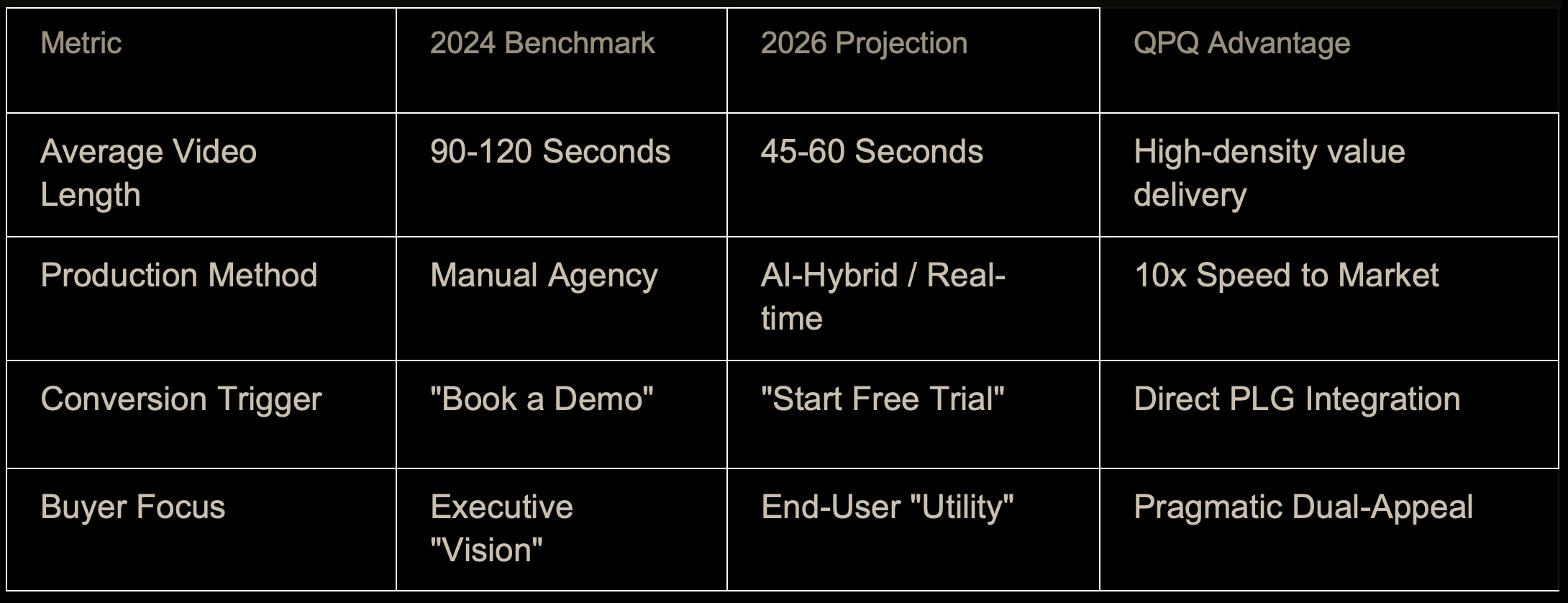
We are seeing a massive compression in attention spans. In 2024, you could get away with a thirty-second intro about “the changing landscape of work.” In 2026, that is a death sentence for your engagement metrics. Buyers want to see the UI. They want to see the cursor move. They want to feel the weight of the software before they even hand over an email address.
The Thesis: Your Video is the Product, Not the Ad
Here is the hill I will die on: If your B2B SaaS Video is handled by a creative team that hasn’t seen your product’s onboarding flow, you are setting money on fire.
The most successful companies in 2026 treat their launch videos as a “Pragmatic PLG” asset. We’ve moved past the era where executives made solo software buying decisions in a vacuum. Today, the end-user is the kingmaker. If the person who actually has to use the tool every day doesn’t see how it makes their life better in the video, the C-Suite won’t sign the check. It does not matter how many ROI charts you throw at them.
If the user thinks the tool looks like a headache, they will veto it. Pragmatic PLG means your video must serve as the first “unofficial” training session. It should be so clear that a viewer feels they could log in and complete a task immediately after watching.
The “Why”: Bridging the Gap Between Users and Leaders
Our internal research at QPQ Marketing Agency shows that the way software is made and sold has shifted dramatically. Blake Bartlett of OpenView coined “product-led growth,” but we advocate for a more grounded version: Pragmatic PLG.
What does that mean for your B2B SaaS Video? It means you must appeal to both the end-user and their leadership team simultaneously. You cannot afford to choose one or the other.
- For the User: Show the delightful, low-friction experience. Show the “Value First” onboarding. Focus on the “micro-wins” like a keyboard shortcut that saves ten minutes or an automated data sync that eliminates manual entry.
- For the Leader: Show the organizational scale and the “Value Realization” at the department level. They need to see the dashboard that aggregates those micro-wins into a macro-result.
Selling into an entire department is still a viable go-to-market strategy, but your video needs to be the bridge. It’s not just about an individual downloading an app. It’s about showing how that app transforms a team’s workflow. If your video only shows one person’s screen, you’re missing the “collateral benefit” that justifies enterprise pricing.
Did You Know?
- 84% of B2B buyers in 2026 report that they are more likely to purchase a SaaS product if the launch video includes a “no-fluff” walkthrough of the actual UI within the first 10 seconds.
- AI-Native SaaS companies using personalized video messaging in their GTM strategy see a 42% higher retention rate during the first 90 days of the customer lifecycle.
The Counter-Argument: “But High Production Value Builds Trust!”
I hear the traditionalists now. They say that a gritty, screen-recorded B2B SaaS Video looks cheap. They argue that you need the $50k cinematic production to look like an enterprise-grade partner.
I get it. Brand matters. But in 2026, authenticity is the new premium. A highly polished video that hides a clunky UI is a bait-and-switch. When the video looks like a Pixar movie but the product looks like Windows 95, you lose trust instantly. The “Traditional vs. QPQ” approach highlights this perfectly:
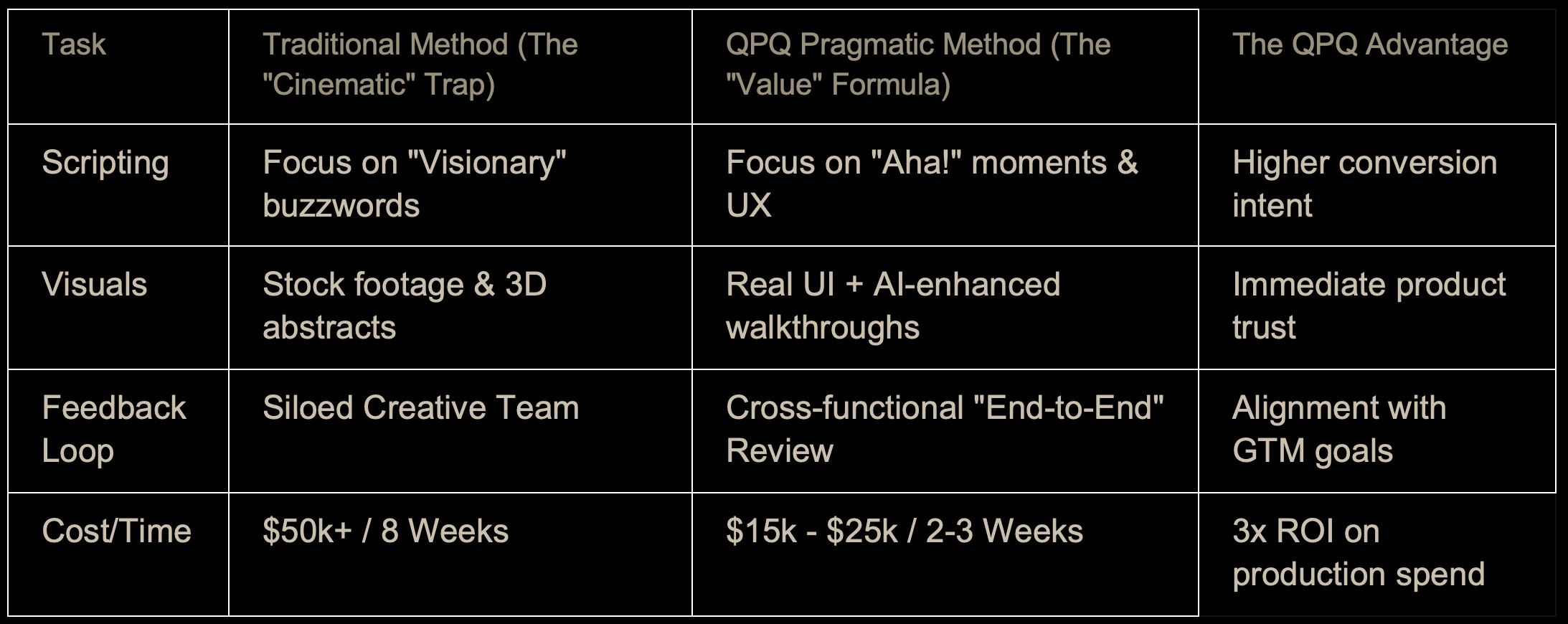
The QPQ method doesn’t mean “low quality.” It means “relevant quality.” It means using AI to enhance the actual product screens so they look beautiful but remain recognizable. It means the motion graphics serve the product, rather than distracting from its absence.
The Psychology of the 2026 Buyer
Why has this shift happened? Because the 2026 buyer is exhausted. They are tired of “Platform Playbooks” and “Synergistic Solutions.” They have a specific problem: maybe their data is siloed, or their team is burning out on manual tasks.
When they watch your B2B SaaS Video, they are looking for a mirror. They want to see their problem reflected and then solved in real-time. If your video spends forty seconds on a metaphor about “sailing the digital seas,” you have failed them. You have signaled that you care more about your brand’s ego than their time.
Pragmatic videos win because they respect the viewer. They assume the viewer is smart enough to understand the value if you just show them the tool. This is why “UI-First” storytelling is the dominant trend. We lead with the interface. We lead with the solution.
The Ritual: The End-to-End Customer Review
If you want your B2B SaaS Video to actually convert, you need to perform what we call the “End-to-End Customer Review” twice a year. This isn’t just a marketing meeting. It is a fundamental audit of your product’s promise versus its reality.
Here’s the gist: Print out or virtually wall-mount screenshots of your entire user experience. Start from the website visitor’s first click and go all the way to the checkout flow. You need to see:
- Shopper pages: What do they see before they sign up?
- Signup process: How many clicks does it take?
- New user onboarding flow: Is the “Aha!” moment immediate?
- Checkout/purchase flow: Is there friction at the finish line?
- Upgrade paths: How do we move them from prosumer to enterprise?
Invite a cross-functional team to review this. If your launch video doesn’t mirror the best parts of this flow, it’s lying to your customers. If your video shows a feature that is actually hidden behind three menus and a support ticket, you are creating “churn debt.”
This ritual forces communication between the product team and the marketing team. It aligns your marketing video with the actual product reality. It’s a core part of an effective growth operating system. When your video is an honest reflection of a great product, your conversion rates don’t just “lift.” They compound.
The Future of Distribution: Beyond the “Play” Button
In 2026, the B2B SaaS Video isn’t just a file on a landing page. It is a modular asset. The “Main Launch Video” is broken down by AI into fifteen different “Micro-Demos” for LinkedIn, three “Deep-Dives” for technical buyers, and a “Visionary Short” for the C-Suite.
The companies winning right now are those that build their videos with this modularity in mind. They don’t create one monolithic 90-second block. They build a sequence of value-rich “chapters.” This allows the sales team to send a specific 15-second clip of the “Reporting Dashboard” to a CFO while sending a 15-second clip of the “API Integration” to a CTO.
This is the ultimate expression of Pragmatic PLG. It is about getting the right “Aha!” moment in front of the right person at the right time.
Closing Thoughts: Don’t Be a Purple Blob
We’ve all been Pete. We’ve all sat through the “Vibe-Only” videos and wondered what the product actually does. Don’t do that to your customers.
The 2026 market doesn’t need more “disruption” through motion graphics. It needs clarity. It needs to see that your software works, that it’s easy to use, and that it solves a real problem for real people.
If you can show the “Aha!” moment in six seconds, you’ve won the first battle. If you can show the organizational value in sixty seconds, you’ve won the deal. Stop selling the dream and start verifying the reality. Your launch video is the first step in that verification. Make it count.