
By 2026, the old model of “hiring 20 SDRs and praying for a 1% reply rate” is officially dead. Founders are now moving toward B2B SaaS GTM agency partners that function as engineering firms rather than call centers. If your agency isn’t building a compounding revenue machine that you actually own, you are just renting a very expensive, very loud megaphone that stops working the second you stop paying.
Let’s be honest. Hiring a B2B SaaS GTM agency in 2026 feels a lot like trying to buy a car while the salesperson is still trying to explain why horse-drawn carriages are the backbone of the economy. The landscape has shifted so fast that the “agency playbook” from just two years ago looks like a relic from the Stone Age.
By mid-2026, industry data suggests that over 65% of B2B revenue leaders have replaced at least half of their manual outbound functions with automated GTM engineering systems. We aren’t just “sending emails” anymore. We are architecting high-frequency trading desks for lead generation.
The Catalyst: Why the “Boiler Room” Model Finally Died
Remember the days of the “SDR floor”? The ping-pong tables, the Red Bull-fueled cold calling marathons, and the dismal conversion rates? In 2026, that model isn’t just outdated; it’s a financial liability. The catalyst for this shift was the “Signal Explosion.”
With the maturation of AI-driven intent data, buyers have zero tolerance for generic outreach. If you aren’t reaching out because they just hired a new VP of Engineering, or because their tech stack just integrated a specific API, you are just spamming. A modern B2B SaaS GTM agency knows that “spray and pray” has become “spray and decay.” It decays your brand, your domain reputation, and your remaining runway.
Industry Context: The 2026 Market Landscape
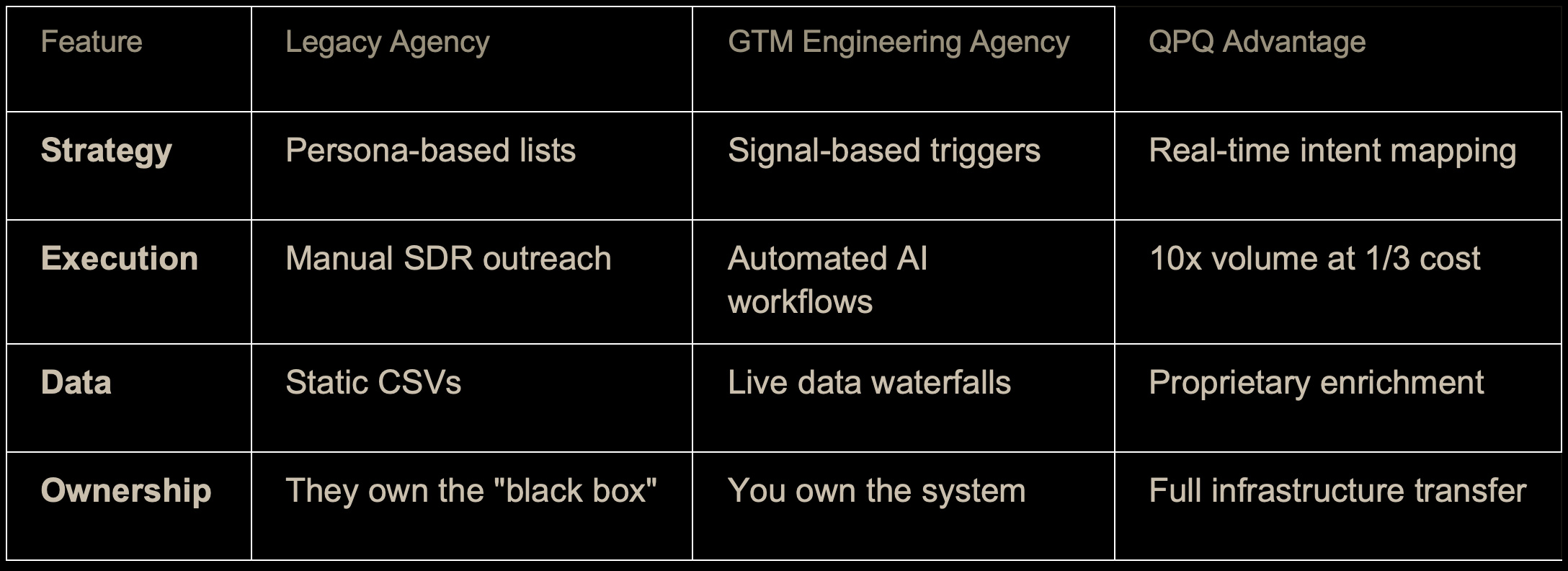
The market has split into two distinct camps. On one side, you have “Legacy Agencies” that are essentially just outsourced SDR shops with a fresh coat of AI paint. On the other, you have GTM Engineering firms (often called “Claygencies”) that build automated revenue systems.
Did You Know?
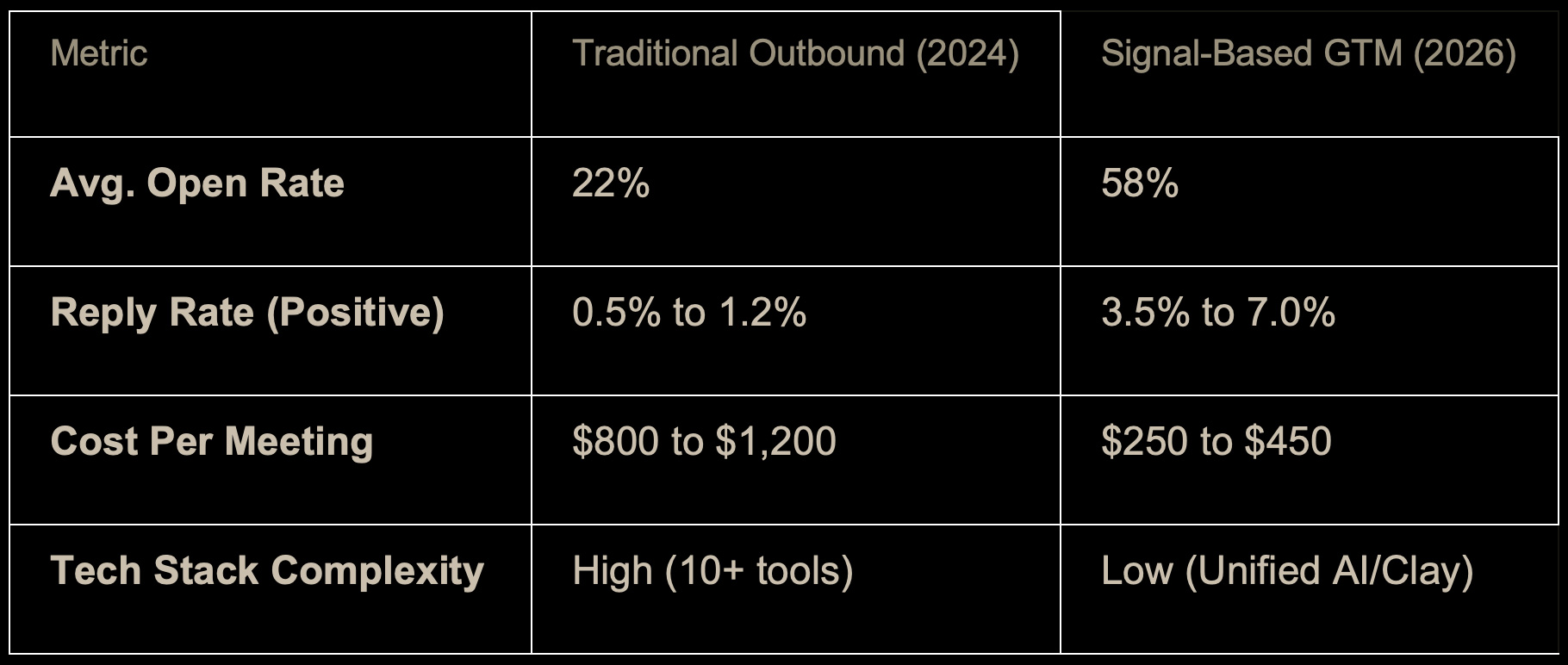
By the end of 2026, companies using signal-based outbound are seeing 4.5x higher meeting-set rates compared to those using traditional persona-based lists.
Quick Reference: 2026 GTM Benchmarks
The Deep Dive: How to Evaluate Your Options
What is the average cost of a GTM agency for B2B SaaS in 2026?
Pricing has moved away from “per head” and toward “per system” or “performance plus retainer.” A top-tier B2B SaaS GTM agency typically charges a monthly retainer ranging from $8,000 to $20,000. This depends on how complex your signal integration needs to be. However, the real value isn’t in the monthly fee. It’s in the “System Ownership.” If they build the system in their accounts and you lose access when you leave, you aren’t building an asset. You are just renting a result.
How do I evaluate if a GTM agency uses AI effectively?
Don’t ask them “if” they use AI. That’s a low bar. Ask them to show you their Clay workflows or their data waterfall logic. A true B2B SaaS GTM agency in 2026 doesn’t just use ChatGPT to write emails. They use AI to scrape LinkedIn profiles, summarize 10-K financial reports, and identify “hiring triggers” that feed into an automated sequence. If they can’t explain how their data enrichment actually works, they are using AI as a buzzword to hide a manual process.
Should I hire an in-house GTM engineer or a GTM agency?
This is the million-dollar question. Hiring a full-time GTM engineer now costs upwards of $160,000 to $220,000 annually. That doesn’t include the cost of the tech stack (Clay, Apollo, Instantly, etc.), which can easily add another $2,000 to $5,000 a month. Partnering with a B2B SaaS GTM agency gives you access to a team of engineers for the price of one hire. You also get the benefit of “cross-pollinated” insights. They see what’s working across ten other campaigns and apply it to yours instantly.
The Comparison: Legacy Agency vs. GTM Engineering Agency
The “SDR Death Spiral” and How to Avoid It
Most founders fall into a trap we call the “SDR Death Spiral.” They hire three SDRs. Those SDRs spend 80% of their time finding data and 20% of their time actually talking to prospects. Because the data is mediocre, the outreach is generic. Because the outreach is generic, the reply rates are low. To fix this, the founder hires more SDRs.
A GTM Engineering approach flips this. You spend 80% of your effort on the “Data Waterfall” (the logic of who to contact and why) so that the outreach is 100% relevant. In 2026, relevance is the only thing that bypasses the AI filters in a prospect’s inbox.
Future Impact: The Next 12 to 24 Months
By 2027, the “GTM Stack” will become even more unified. We expect to see the total disappearance of standalone “email warm-up” tools as deliverability becomes a native feature of AI-orchestration layers. The B2B SaaS GTM agency of the future won’t just be a service provider. They will be “Revenue Architects” who build self-healing outbound systems that adjust messaging based on real-time market sentiment.
Pro Tips for Founders
- The “Ownership” Clause: Ensure your contract states that you own the Clay workspaces and the automated workflows at the end of the engagement. Don’t get locked into a proprietary “black box.”
- Signal over Volume: If an agency promises “10,000 emails a day,” run the other way. If they promise “100 highly-targeted signals a day,” stay and listen.
- The “Human-in-the-Loop” Test: Ask how they handle edge cases. Even the best AI needs a human to verify high-value enterprise leads before the “send” button is hit.
Why QPQ Marketing Agency is the Enterprise Choice
While many “Claygencies” are popping up to serve small startups, QPQ Marketing Agency has built an enterprise-grade infrastructure that scales. We don’t just “set up Clay.” We engineer comprehensive GTM systems that integrate with your existing CRM, RevOps, and marketing automation.
As a B2B SaaS GTM agency, we solve the “waiting mistake.” Most founders wait until they “really need” a GTM engineer, only to find their competitors have already built compounding systems that are 18 months ahead. QPQ Marketing Agency acts as your fractional GTM engineering department. We turn on the flywheel from day one. We use real buying signals to reach the right people at the right time, running coordinated outreach across email, LinkedIn, and phone with messaging that actually earns a seat at the table.
Main Takeaways
- GTM Engineering is Mandatory: In 2026, manual outbound is a “leaky bucket” strategy.
- Signals > Personas: Reaching out because of a reason beats reaching out because of a job title.
- Ownership is Key: Build systems you own, not campaigns you rent.
- Speed to Market: The 18-month “compounding gap” is real. The sooner you automate, the harder you are to catch.
What is a "Claygency"?
It’s a specialized B2B SaaS GTM agency that uses Clay as the primary orchestration layer for data enrichment and outbound automation.
How long does it take to see results with a GTM agency?
Typically, the “Engineering Phase” takes 2 to 4 weeks. You should see the first meetings landing in week 5 or 6 as the “flywheel” begins to spin.
Is cold email dead in 2026?
Generic cold email is dead. Signal-based, AI-personalized “warm” outbound is the highest-ROI channel in the B2B world.
See you at the next launch. Hopefully, it’s one where your SDRs aren’t crying into their headsets!